

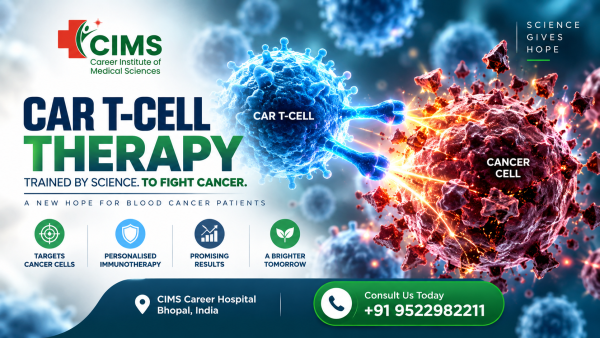
CIMS Career Hospital Bhopal guides patients exploring CAR T-cell therapy for blood cancer, one of the most significant advances in cancer immunotherapy and a treatment that has changed the outlook for some patients with difficult-to-treat blood cancers.
Imagine if a patient's own immune cells could be trained to recognise and attack cancer.
That is the basic idea behind CAR T-cell therapy.
Over the years, cancer treatment has progressed from broadly acting treatments such as chemotherapy towards increasingly targeted approaches. Today, scientists are going one step further: using living immune cells as a treatment.
For certain blood cancers, this is no longer just an experimental concept. CAR T-cell therapies are now approved and used in major healthcare systems, including the United States, and have produced long-lasting remissions in some patients with advanced disease.
From Chemotherapy to Immunotherapy: How Cancer Treatment Has Evolved
Chemotherapy works by using medicines that can destroy rapidly dividing cancer cells. Radiation therapy uses high-energy radiation to damage cancer cells, while targeted therapies are designed to interfere with particular molecules involved in cancer growth.
Immunotherapy works differently.
Instead of directly attacking cancer with a conventional drug, it uses or strengthens the body's immune response against cancer.
CAR T-cell therapy takes this concept into the realm of cell therapy.
Rather than simply giving the patient a medicine, doctors collect immune cells from the patient, modify them and return them to the body as a living treatment.
The National Cancer Institute describes CAR T cells as a type of “living drug” because the cells can remain active in the body after they have been infused.
What Exactly Is a CAR T Cell?
T cells are immune cells that play an important role in identifying abnormal cells.
But cancer cells can sometimes escape immune detection.
Scientists developed a way to give T cells an additional recognition system: a chimeric antigen receptor, or CAR.
The CAR is engineered to recognise a particular protein, known as an antigen, on the surface of cancer cells.
For example, many CAR T-cell therapies used against B-cell cancers target CD19, while some therapies for multiple myeloma target BCMA.
When the engineered T cell encounters its target, the CAR sends signals that activate the cell, allowing it to attack the cancer cell.
How Are a Patient's T Cells Turned Into Cancer-Fighting Cells?
The science behind CAR T-cell therapy is complex, but the basic concept can be explained simply.
First, the T cells are collected.
Blood is taken from the patient and processed to separate the required immune cells.
Next, the cells are genetically engineered.
The laboratory introduces genetic instructions that allow the T cells to produce the CAR receptor.
The modified cells are then multiplied.
Large numbers of these engineered cells are produced for treatment.
Finally, the cells are returned to the patient.
After the necessary preparation, the CAR T cells are infused back into the bloodstream.
Once inside the body, they can seek out cells carrying their specific target.
This is what makes CAR T-cell therapy different from many conventional cancer treatments: the treatment itself is made from the patient's own immune cells.
Has CAR T-Cell Therapy Really Worked?
This is where the development becomes particularly significant.
The first CAR T-cell therapy was approved by the U.S. FDA in 2017, for certain children and young adults with B-cell acute lymphoblastic leukaemia (ALL). Since then, additional CAR T-cell therapies have been approved for several blood cancers, including lymphomas and multiple myeloma.
And the clinical results have been striking.
In the pivotal ELIANA trial of children and young adults with relapsed or refractory B-cell ALL, 83?hieved remission within three months of receiving tisagenlecleucel. Follow-up data showed that approximately half of the 79 patients remained free of disease at 36 months, while 63% were still alive.
In a clinical trial involving advanced follicular lymphoma, nearly 80% of patients treated with axicabtagene ciloleucel had their cancer eliminated. In studies of large-cell lymphoma, more than 30% of participants were alive without evidence of cancer five years after treatment. (Cancer.gov)
These numbers do not mean that CAR T-cell therapy has the same success rate for every blood cancer. Outcomes vary according to the disease, treatment product, previous therapies and individual patient.
But they demonstrate why CAR T-cell therapy has become such an important development in oncology.
CAR T-Cell Therapy Is Now Part of Modern Cancer Medicine
There was once a question about whether CAR T-cell therapy would remain a specialised treatment used only in research settings.
That question has largely been answered.
The NCI now describes CAR T-cell therapy as part of modern medicine, with multiple FDA-approved therapies for blood cancers.
The FDA's current list of approved cellular and gene therapy products includes multiple CAR T-cell products, including Kymriah, Yescarta, Tecartus, Breyanzi, Abecma and Carvykti. These products have different approved uses.
This growing number of approved therapies reflects how rapidly the field has developed since the first approval less than a decade ago.
What Blood Cancers Can Be Treated With CAR T-Cell Therapy?
CAR T-cell therapy is currently most established for certain blood cancers, rather than cancer in general.
Depending on the specific therapy, approved uses include selected forms of:
-
B-cell acute lymphoblastic leukaemia
-
Large B-cell lymphoma
-
Follicular lymphoma
-
Mantle cell lymphoma
-
Other B-cell lymphomas
-
Multiple myeloma
The important point is that different CAR T-cell therapies have different indications.
A treatment approved for one blood cancer cannot automatically be assumed to work for another.
CAR T-cell therapy is also being investigated for solid tumours, but its use in most solid cancers remains experimental.
What Are the Limitations?
Despite the remarkable results, CAR T-cell therapy is not a universal cure.
Some patients respond strongly and experience long-lasting remission. Others may have only a partial response, may not respond at all, or may eventually relapse.
There are also important treatment-related risks.
One of the best-known complications is cytokine release syndrome (CRS), an inflammatory reaction that can cause fever, low blood pressure and other serious symptoms.
Some patients can also experience neurological complications.
CAR T-cell therapies therefore require specialised clinical monitoring and rapid management of complications when they occur. The FDA has maintained safety requirements around these therapies because of these risks.
In addition, the FDA has required a boxed warning regarding the rare but serious risk of T-cell malignancies following certain CD19- or BCMA-directed CAR T-cell therapies.
These risks do not negate the benefits of CAR T-cell therapy, but they highlight why careful patient selection and specialist supervision are essential.
Who May Be Considered for CAR T-Cell Therapy?
CAR T-cell therapy is generally considered for selected patients whose cancer fits the approved indication for a particular CAR T-cell product.
Doctors may consider factors such as:
-
The exact type and subtype of blood cancer
-
Previous treatments
-
Whether the disease has returned or is refractory
-
Current disease status
-
Age
-
General health
-
Organ function
-
The specific CAR T-cell therapy available
Therefore, an online article or a reported success rate cannot determine whether an individual patient is suitable.
A haematologist or medical oncologist must evaluate the patient's complete medical history and investigationsbefore recommending CAR T-cell therapy.
What Could the Future of CAR T-Cell Therapy Look Like?
The story of CAR T-cell therapy is still being written.
Researchers are working on ways to make CAR T cells more effective, improve their ability to remain active in the body, reduce side effects and overcome cancer resistance.
Scientists are also investigating new targets and exploring whether CAR T technology can be used against cancers beyond the blood cancers for which it is currently established.
Another major area of research is the development of next-generation and potentially “off-the-shelf” cell therapies, which could eventually make treatment faster and easier to manufacture.
These developments could determine how widely cell therapy is used in the future.
CAR T-Cell Therapy in Bhopal: Exploring an Advanced Treatment Option
For patients searching for CAR T therapy in Bhopal, the growing availability of advanced cell-based cancer treatment represents an important development.
CIMS Career Hospital Bhopal has tied up with ImmunoACT, giving eligible patients an opportunity to explore India's indigenous CAR T-cell therapy.
CIMS is also NABH accredited, adding an important consideration for patients evaluating advanced cancer-care facilities.
The appropriate next step for a patient is not to assume that CAR T-cell therapy will be suitable, but to undergo a specialist evaluation to understand whether the treatment fits their particular diagnosis and clinical situation.
CAR T-Cell Therapy: A New Direction in Cancer Care
CAR T-cell therapy represents a major shift in the way scientists think about cancer treatment.
It brings together immunology, genetic engineering and cell therapy to create a treatment that uses the patient's own immune system as a weapon against cancer.
For some blood cancer patients, this approach has already changed what is medically possible.
For researchers, it opens an even bigger question: if immune cells can be engineered to recognise one type of cancer, what else might they be engineered to do?
That question is driving the next generation of cancer research.
Exploring CAR T-Cell Therapy at CIMS Career Hospital Bhopal?
If you or a loved one has a blood cancer and wants to understand whether CAR T-cell therapy may be an option, speak with a qualified haematologist or medical oncologist.
CIMS Career Hospital Bhopal can guide patients through specialist evaluation and the next steps in exploring advanced cancer treatment.
For CAR T-cell therapy consultations and international patient assistance:
Call/WhatsApp: +91 95229 82211
CAR T-cell therapy is not suitable for every patient. Treatment eligibility, response rates, risks and outcomes vary according to the individual patient, cancer type and specific CAR T-cell product used. Medical treatment decisions should always be made in consultation with a qualified specialist.