

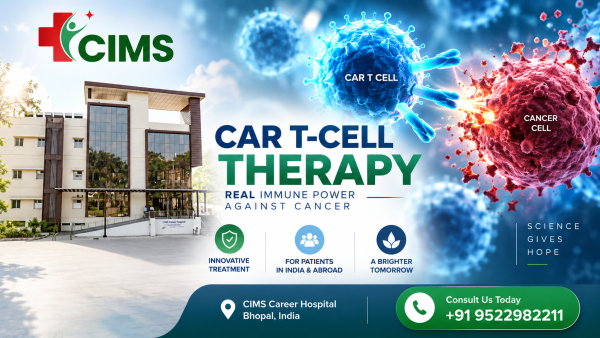
CIMS Career Hospital Bhopal guides patients exploring CAR T-cell therapy in Bhopal, an advanced form of cancer immunotherapy that has become an established treatment option for certain blood cancers in India and around the world.
Cancer treatment is changing rapidly. Alongside chemotherapy, radiation, targeted therapy and immunotherapy, CAR T-cell therapy has emerged as one of the most important developments in modern cancer care.
But what exactly is CAR T-cell therapy? How effective is it? Which cancers can it treat? And why is India gaining attention for making this advanced treatment more affordable?
For patients searching for CAR T-cell therapy in Bhopal, understanding these questions can be an important first step.
What Is CAR T-Cell Therapy?
CAR T-cell therapy is a type of personalised cancer immunotherapy that uses a patient's own immune cells.
T cells are collected from the patient's blood and sent for specialised processing. In the laboratory, they are genetically modified to carry a chimeric antigen receptor (CAR). This receptor helps the T cells recognise a particular target on cancer cells.
The modified cells are then multiplied and returned to the patient through an infusion.
In simple terms, CAR T-cell therapy reprograms a patient's immune cells to better recognise and attack certain cancer cells.
The treatment is mainly used for certain blood cancers. CAR T-cell therapy is still being studied for many solid tumours and is not currently an established treatment for most solid cancers.
How Does CAR T-Cell Therapy Work?
The treatment generally involves several stages:
1. T-Cell Collection
The patient's blood passes through a specialised machine that separates and collects T cells. The remaining blood components are returned to the patient.
2. Genetic Modification
The collected T cells are modified in a specialised laboratory so that they carry a CAR designed to recognise a specific cancer-related protein.
3. Cell Expansion
The modified cells are multiplied until there are enough cells to create the treatment dose.
4. Preparation for Treatment
Before receiving the CAR T cells, patients generally receive lymphodepleting chemotherapy. This helps prepare the body for the infused cells.
5. CAR T-Cell Infusion
The modified cells are infused back into the patient. Once inside the body, they can recognise cells carrying the specific target and attack them.
6. Close Monitoring
CAR T-cell therapy requires careful monitoring because some patients can develop serious immune-related side effects after treatment.
The exact process and timing can vary according to the CAR T-cell product and the patient's condition.
How Effective Is CAR T-Cell Therapy?
This is one of the most important questions patients ask.
CAR T-cell therapy has produced significant responses in several types of blood cancer, particularly in patients whose disease has returned or stopped responding to earlier treatments.
The results vary considerably depending on the cancer, CAR T-cell product and patient population.
For example, the U.S. National Cancer Institute reports that in a clinical trial involving advanced follicular lymphoma, nearly 80% of patients treated with axicabtagene ciloleucel had their cancer eliminated, while long-term follow-up has shown that many patients remained disease-free years later. In large-cell lymphoma trials, more than 30% of participants were alive without evidence of cancer five years after treatment.
For multiple myeloma, NCI reports complete remission rates of approximately 50% to 65% in selected non-randomised studies of BCMA-directed CAR T-cell therapies.
These figures should not be interpreted as a guarantee for an individual patient. Outcomes depend on the specific cancer, treatment history and CAR T-cell therapy being used.
What About India's CAR T-Cell Therapy?
India has made an important contribution to the development of more affordable CAR T-cell treatment.
NexCAR19™, developed in India by ImmunoACT with roots at IIT Bombay, became India's first approved CAR T-cell therapy in October 2023. It is a CD19-directed CAR T-cell therapy for specific relapsed or refractory B-cell malignancies.
The clinical results were significant.
In the studies that supported its development, 67% of evaluable patients had an objective response, meaning their cancer showed a meaningful reduction. Approximately half achieved a complete response, according to data reported to the American Society of Hematology and summarised by the National Cancer Institute.
A later analysis has reported an overall response rate of approximately 73% among efficacy-evaluable patients, with a complete response rate of around 53%.
These results helped establish India's homegrown CAR T-cell therapy as an important development in the field.
Is CAR T-Cell Therapy Globally Accepted?
Yes. CAR T-cell therapy is no longer considered merely an experimental idea.
The U.S. Food and Drug Administration (FDA) approved the first CAR T-cell therapy in 2017. Since then, multiple CAR T-cell products have received approval for different blood cancers, including certain forms of acute lymphoblastic leukaemia, lymphomas and multiple myeloma.
The National Cancer Institute describes CAR T-cell therapies as having become part of modern medicine, following clinical trials demonstrating substantial responses in advanced blood cancers.
At the same time, research continues. Scientists are studying CAR T-cell therapy earlier in the treatment journey and investigating new targets and applications.
Which Cancers Can CAR T-Cell Therapy Treat?
CAR T-cell therapy is currently most established for certain blood cancers, rather than all cancers.
Depending on the specific product and regulatory approval, CAR T-cell therapies may be used for certain:
- B-cell acute lymphoblastic leukaemias
- B-cell lymphomas
- Large B-cell lymphomas
- Follicular lymphomas
- Mantle cell lymphoma
- Multiple myeloma
Different CAR T-cell products target different proteins, such as CD19 or BCMA, and their approved uses are not interchangeable.
For this reason, a patient should never assume that CAR T-cell therapy is suitable simply because they have cancer. A specialist must determine eligibility.
CAR T-Cell Therapy in Bhopal: Access to Advanced Treatment
For patients looking for CAR T-cell therapy in Bhopal, access to advanced cell therapy closer to home can be particularly valuable.
CAR T-cell treatment involves more than the infusion itself. Patients require evaluation, preparation, hospital care and monitoring before and after treatment.
Travelling repeatedly to another city can add physical, emotional and financial pressure for patients and their families.
CIMS Career Hospital Bhopal gives patients in Bhopal and Central India an option to explore CAR T-cell therapy through specialist evaluation.
The hospital has a tie-up with ImmunoACT, making it relevant for patients being evaluated for India's indigenous CAR T-cell therapy.
CIMS Career Hospital Bhopal is also NABH accredited, adding an important quality and safety consideration for patients looking for advanced cancer care.
Why Is CAR T-Cell Therapy More Affordable in India?
One of the biggest challenges with CAR T-cell therapy internationally has been its cost.
The treatment requires complex cell collection, genetic modification, laboratory manufacturing and specialised clinical care. In countries such as the United States, CAR T-cell therapies can have very high treatment costs.
India's development of an indigenous CAR T-cell therapy has helped change this picture.
According to the National Cancer Institute, NexCAR19 was expected to cost around US$50,000, compared with approximately US$400,000 for a CAR T-cell infusion in the United States at the time the Indian therapy was being introduced.
Actual treatment costs can vary, and the total expense may include hospitalisation, investigations, preparatory treatment and supportive care.
Nevertheless, India's ability to develop and manufacture CAR T-cell therapy domestically has created a significant affordability advantage.
What Are the Risks of CAR T-Cell Therapy?
Like any advanced cancer treatment, CAR T-cell therapy can cause side effects.
One of the best-known complications is cytokine release syndrome (CRS). It can cause symptoms such as fever, low blood pressure and breathing difficulties and may require urgent treatment.
Neurological side effects, sometimes referred to as ICANS, can also occur with some CAR T-cell therapies.
The risk and severity depend on the particular therapy and patient.
Interestingly, early NexCAR19 studies reported a relatively low rate of severe CRS, with the National Cancer Institute noting that only about 5% of patients experienced severe CRS in the reported trials, and no patients in those studies experienced the neurological side effects commonly seen with some U.S.-approved CAR T therapies.
This does not mean side effects cannot occur. Patients require appropriate monitoring and specialist care throughout the treatment process.
Who Should Consider CAR T-Cell Therapy?
CAR T-cell therapy may be considered for selected patients whose cancer meets the approved indication for a particular CAR T-cell product.
For NexCAR19, this includes specific cases of relapsed or refractory B-cell acute lymphoblastic leukaemia and B-cell lymphomas.
A specialist will consider factors such as:
- Type and subtype of cancer
- Previous treatments
- Whether the cancer has returned or become resistant
- Disease status
- Patient's age and overall health
- Organ function and other medical factors
A detailed medical evaluation is therefore essential before treatment.
CAR T-Cell Therapy at CIMS Career Hospital Bhopal
For patients searching for CAR T-cell therapy in Bhopal, CIMS Career Hospital Bhopal can be a starting point for specialist evaluation and understanding the treatment pathway.
Patients from other parts of India can also explore treatment options in Bhopal, while international patients may seek assistance in understanding the medical evaluation and treatment process before travelling.
The most important step is to determine whether CAR T-cell therapy is appropriate for the individual patient.
Exploring CAR T-Cell Therapy in Bhopal?
CAR T-cell therapy has moved from an experimental concept to an established treatment option for several blood cancers worldwide. At the same time, India's homegrown CAR T-cell technology is helping make this advanced treatment more accessible.
If you or a loved one is searching for CAR T-cell therapy in Bhopal, consult a qualified specialist to understand eligibility, expected benefits, risks and costs.
CIMS Career Hospital Bhopal
For CAR T-cell therapy consultations and international patient assistance:
Call/WhatsApp: +91 95229 82211
Medical treatment decisions should always be made in consultation with a qualified treating specialist. Treatment availability, eligibility, outcomes, risks and costs vary according to the individual patient and the specific CAR T-cell therapy used.